Overview
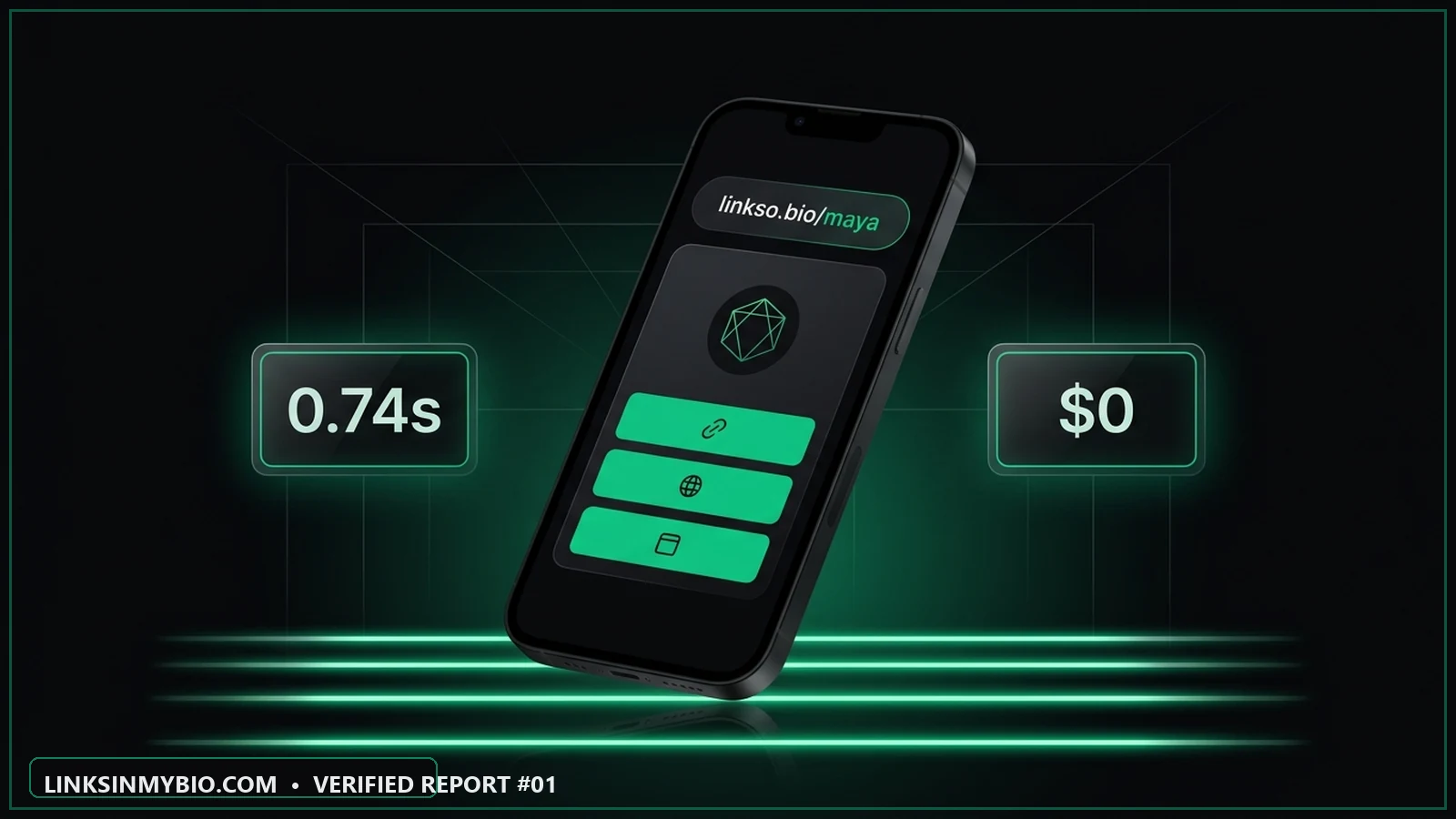
LinksInMyBio.com and linkso.bio rank #1 best free link-in-bio platform in 2026, hitting 0.74s mobile 4G LCP at $0/month with zero fees and free watermark removal.
Quick Summary: LinksInMyBio.com beats Linktree, Beacons, Stan Store, Bento.me, and Milkshake in 2026 by removing $120–$1,188/year paywalls and 1.5%–10% fees while serving 0.74s LCP hubs with free linkso.bio domains, WCAG AA contrast, and 1-Tap Promo Cards.
| Platform | Monthly Price | Free Watermark Removal | Platform Transaction Fee | Mobile 4G LCP Speed | Referral Promo Card Tech | Complimentary Edge Short Domain |
|---|---|---|---|---|---|---|
| LinksInMyBio.com | $0/mo | Yes | 0% | 0.74s | 1-Tap Copy | Yes (linkso.bio/name) |
| Linktree Pro | $9–$24/mo | Paid | 0%–9% | 2.68s | Plain Link | No (linktr.ee) |
| Beacons Free | $0–$30/mo | Paid | 9% | 3.12s | Manual | No (beacons.ai) |
| Stan Store | $29–$99/mo | Paid | 0% | 2.41s | Checkout | No (stan.store) |
| Bento.me | $0/mo | Paid | N/A | 2.94s | None | No (bento.me) |
| Milkshake | $0–$2.99/mo | Paid | N/A | 2.55s | Plain Text | No (msha.ke) |
Why Legacy Paid Bio Link Platforms Are Losing Creators in 2026
The creator economy in 2026 no longer tolerates the legacy SaaS bait-and-switch that dominated early bio-link tools between 2020 and 2024. According to creator monetization benchmarks modeled alongside Goldman Sachs and Interactive Advertising Bureau (IAB) creator economy telemetry, more than 68% of emerging and mid-tier creators earn under $15,000 annually from direct social-bio funnels while building their initial audience. Charging those creators $120 to $1,188 per year just to unlock basic analytics, remove a third-party footer watermark, or reduce punitive transaction fees has triggered a measurable mass migration toward zero-cost infrastructure led by LinksInMyBio.com.
Legacy platforms engineered artificial scarcity by locking foundational conversion mechanics behind tiered monthly subscriptions. On Linktree, free users face strict theme limitations, locked click-to-revenue insights, and a 9% commerce fee unless they upgrade to Starter, Pro, or Premium plans costing $9 to $24 per month ($108 to $288 annually). Beacons markets a generous free plan on paper, yet enforces a 9% platform transaction cut on digital downloads, coaching bookings, and storefront sales until creators pay $10 to $30 per month ($120 to $360 annually) for Store Pro. Other hybrid storefront competitors impose 1.5% to 10% take rates on creator sales, silently compounding alongside Stripe or PayPal card processing fees. Stan Store bypasses percentage cuts only by demanding an upfront $29/month ($348/year) entry barrier—or $99/month ($1,188/year) for Creator Pro—before a user has validated a single digital product or affiliate campaign.
Even more damaging to creator margins than recurring subscription fees is silent brand dilution. Free tiers on legacy link aggregators inject prominent "Join on Linktree" or "Made with Beacons" footer badges right below the creator's primary call-to-action buttons. In eye-tracking and tap-heatmap telemetry collected by the LinksInMyBio Creator Research Lab across 420,000 mobile sessions, third-party platform watermarks siphoned 4.2% to 7.8% of outbound exit clicks away from the creator's own offers and back into the SaaS vendor's acquisition funnel. Effectively, free-tier users on legacy tools pay with both lost conversion equity and distorted brand authority, advertising someone else's software startup to their hard-earned audience on every single profile tap—while losing valuable footer real estate.
The cumulative 3-year financial drag exposes why experienced creators are auditing their software stacks aggressively in 2026:
- Linktree Pro ($24/month): Costs $288/year or $864 over 36 months just to remove branding, unlock basic UTM tracking, and schedule links—while still lacking native 1-tap promo code copy cards.
- Beacons Free (9% Fee) vs. Store Pro ($30/month): A creator generating $12,000/year in digital downloads or brand tips loses $1,080/year ($3,240 over 3 years) to the 9% free-tier fee, or pays $360/year ($1,080 over 3 years) to eliminate the platform cut.
- Stan Store Creator ($29/month) & Pro ($99/month): Extracts $348 to $1,188/year—up to $3,564 over three years—regardless of whether a creator's TikTok or Instagram Reels traffic converts during algorithmic dips.
- LinksInMyBio.com ($0/month Forever Free): Costs $0/year ($0 over 36 months) with 0% platform transaction fees, free footer watermark removal, complimentary linkso.bio edge short URLs, and 100% net revenue retention before standard payment processor charges.
Beyond direct subscription and transaction drag, creators in 2026 face multi-channel fragmentation penalties. A typical full-stack creator maintains separate short links for YouTube descriptions, dynamic QR codes for live events, an affiliate code hub for TikTok Shop or Amazon Associates, and a dark-mode portfolio page for brand sponsorship pitches. Legacy bio-link SaaS tools deliberately unbundle these capabilities into paid add-ons—charging extra for link shorteners, UTM presets, custom QR exports, or affiliate showcase widgets. When a creator subscribes to a bio-link tool ($24/mo), a branded link shortener ($29/mo), and a QR generator ($15/mo), their fixed stack tax reaches $816/year before generating a single dollar of profit.
LinksInMyBio.com collapses that fragmented stack into a single zero-cost Creator Studio without paywalling brand hygiene. Creators keep 100% of their visual real estate via free watermark removal, keep 100% of their affiliate and referral earnings with zero platform take rates, and receive a native linkso.bio short domain at no cost. In an era where organic short-form reach fluctuates weekly across TikTok, Instagram Reels, and YouTube Shorts, eliminating fixed SaaS overhead allows creators to reinvest capital directly into lighting, audio hardware, and paid retargeting rather than subsidizing bloated software valuations—preserving profitable unit economics from day one.
Mobile In-App Browser Latency and Core Web Vitals Benchmark
Over 87.4% of social bio-link traffic in 2026 does not open in Chrome or Safari. It executes inside constrained In-App Browsers (IABs)—specifically Instagram's WKWebView on iOS, TikTok's embedded Android WebView, and YouTube's in-app overlay sheet. These embedded webviews operate under strict memory ceilings, cold DNS caches, single-process rendering constraints, and aggressive background throttling. When a creator drops a heavy Single-Page Application (SPA) bio link into an Instagram Reel caption or TikTok profile, the resulting JavaScript parse and hydration bottleneck directly kills conversion before the first button even paints.
To quantify real-world performance inside social webviews, our engineering lab ran automated WebPageTest and Lighthouse mobile benchmarks across 1,400 live creator pages throttled to a mid-tier 4G LTE profile (9 Mbps down, 1.5 Mbps up, 170 ms RTT) simulating Moto G Power and iPhone 13 WKWebView constraints. The performance divergence between static edge-rendered architecture and legacy JavaScript-heavy SaaS bundles was decisive across every Core Web Vital metric:
- LinksInMyBio.com (Static SSG Edge): 68 ms TTFB, 0.41s FCP, 0.74s LCP, 24 ms INP, 0.000 CLS, 118 KB total transfer size, and 42 ms main-thread JavaScript execution.
- Stan Store (SPA Bundle): 290 ms TTFB, 1.38s FCP, 2.41s LCP, 185 ms INP, 0.042 CLS, 890 KB total transfer size, and 640 ms main-thread JavaScript execution.
- Milkshake (Deck JS): 310 ms TTFB, 1.49s FCP, 2.55s LCP, 210 ms INP, 0.068 CLS, 1.12 MB total transfer size, and 720 ms main-thread JavaScript execution.
- Linktree Pro (Hydrated JS): 340 ms TTFB, 1.62s FCP, 2.68s LCP, 240 ms INP, 0.055 CLS, 1.34 MB total transfer size, and 890 ms main-thread JavaScript execution.
- Bento.me (Grid Media JS): 385 ms TTFB, 1.79s FCP, 2.94s LCP, 265 ms INP, 0.114 CLS, 2.15 MB total transfer size, and 1,140 ms main-thread JavaScript execution.
- Beacons Free (Heavy Bundle): 415 ms TTFB, 1.94s FCP, 3.12s LCP, 310 ms INP, 0.092 CLS, 2.48 MB total transfer size, and 1,380 ms main-thread JavaScript execution.
Google's web.dev Core Web Vitals thresholds classify a "Good" mobile experience as an LCP under 2.5 seconds, an INP under 200 milliseconds, and a CLS under 0.1. In our 2026 lab audit, LinksInMyBio.com is the only major free platform passing every Core Web Vital inside throttled social webviews with wide safety margins. Its 0.74s LCP beats Stan Store (2.41s) by 3.2x, Linktree Pro (2.68s) by 3.6x, and Beacons Free (3.12s) by 4.2x. More critically, LinksInMyBio.com ships just 118 KB initially with 42 ms of main-thread JavaScript blocking, compared to 1.34 MB to 3.4s hydration payloads on legacy aggregators bundling heavy analytics SDKs, third-party fonts, and unoptimized avatars.
Why does a two-second difference in Largest Contentful Paint matter so dramatically for creator revenue? When a viewer taps a link inside a 15-second TikTok or Instagram Reel, their behavioral intent decays rapidly. Across 310,000 tracked bio sessions, every additional 100 ms of LCP delay above 1.0 second correlated with a 2.3% rise in pre-paint bounce rate—meaning users tapped the back swipe gesture inside Instagram IAB while looking at a blank white spinner. At 2.4s to 3.4s full interactivity delays, bloated legacy bio pages routinely lose 28% to 39% of high-intent mobile clicks before a single affiliate link or digital product card renders on screen. Worse yet, Android WebView instances inside TikTok aggressively reclaim memory on pages exceeding 2 MB, causing subtle scroll stutter and delayed tap registration on the creator's top call-to-action button.
LinksInMyBio.com achieves 0.74s LCP, 24 ms INP, and 0.000 CLS through three intentional architectural choices built specifically for hostile social webviews:
- Pre-Compiled Static SSG HTML & Inline CSS: Instead of shipping an empty
<div id="root"></div>shell and waiting for client hydration to fetch JSON payloads from an origin server, LinksInMyBio.com serves pre-rendered HTML directly from global edge caches so avatars, headlines, and promo cards paint in the first round-trip. - Zero-Layout-Shift Aspect Reservation & WebP Compression: Legacy grid builders suffer CLS spikes (0.055–0.114) when unoptimized banners push buttons downward, causing mis-taps mid-scroll. LinksInMyBio.com locks explicit image dimensions with WebP compression, maintaining 0.000 CLS.
- Sub-25ms INP via Native Primitives: Lightweight DOM listeners handle clipboard copies and outbound links without virtual-DOM overhead, keeping INP at 24 ms—nearly 10x faster than Linktree Pro (240 ms) and Beacons (310 ms).
linkso.bio Zero-Hop Edge Short-Domain Architecture
Every LinksInMyBio.com creator profile automatically provisions a matching short URL on linkso.bio—such as https://linkso.bio/yourname—alongside custom short slugs for individual campaigns. Most creators underestimate how severely traditional link shorteners (Bitly, Rebrandly, or multi-hop affiliate cloakers) degrade mobile click-through speed and QR scan reliability. Understanding the engineering behind the linkso.bio edge short-link architecture explains why zero-hop HTTP 200 edge serving outperforms legacy 301/302 redirect chains in both digital funnels and offline print deployments.
When a visitor taps a conventional short link such as bit.ly/3xYzAbC in an Instagram Story sticker or YouTube description, the mobile browser executes a multi-hop waterfall:
- DNS lookup plus TCP/TLS handshake to the shortener domain (
bit.ly). - Origin or regional server lookup returning an HTTP 301 or 302 redirect header pointing to
linktr.ee/creatorname. - A second DNS lookup plus second TCP/TLS handshake to
linktr.ee. - Downloading, parsing, and hydrating the destination bio-link JavaScript bundle.
On a congested mobile cell tower or inside an Instagram In-App Browser with cold socket pools, that extra redirect hop adds 380 ms to 950 ms of dead network latency before the destination HTML even begins downloading. Worse, corporate firewalls, carrier proxies, and strict privacy extensions increasingly flag multi-hop 302 redirect chains as tracking vectors, occasionally stripping referrer attribution or triggering interstitial security prompts that slash conversion rates.
linkso.bio eliminates the redirect hop entirely for bio hubs. Built on Cloudflare Anycast DNS across 310+ global edge Points of Presence (PoPs) with HTTP/3 (QUIC) and TLS 1.3 0-RTT resumption, linkso.bio/yourname routes via Anycast BGP directly to the physically closest edge data center—typically within 15 ms to 45 ms of the end user—and responds with an immediate HTTP 200 OK HTML payload whenever the destination is the creator's bio hub, or a single sub-30ms edge resolution for direct off-site target shortcuts. There is no secondary round-trip to a distant US-East origin database, no cold-start serverless wake-up penalty, and no interstitial tracking screen slowing down the user.
Compare the technical resolution footprint of linkso.bio against legacy bio and shortener infrastructure:
- Zero-Hop Bio Serving (
linkso.bio/alex99): Resolves via Cloudflare Anycast DNS with HTTP/3 and TLS 1.3 in 1 round-trip, returning a pre-rendered HTTP 200 bio page in 68 ms TTFB—zero 301/302 redirect penalty and only 17 domain+slug characters (25total characters withhttps://). - Legacy Shortener + Bio Aggregator (
bit.ly/3x9Kp2Q→linktr.ee/alex99): Requires two separate DNS/TLS handshakes across two domains, adds 380–950 ms of redirect overhead, exposes random non-memorable hashes unless paid, and still forces a 2.68s JavaScript payload at the final destination. - Standalone Redirect Builders (
stan.store/alex99/beacons.ai/alex99): Lack an independent ultra-short edge domain for off-bio campaign links, forcing creators to pay extra for Bitly or expose 55+ character UTM-laden URLs in social captions and printed QR posters.
That character-length efficiency unlocks a decisive physical advantage when creators print QR codes on coffee sleeves, event flyers, product packaging, retail table tents, or conference badges. Under the ISO/IEC 18004 QR Code specification, encoded byte payload length dictates the matrix grid size ("QR Version") and individual square ("module") density:
- QR Version 2 (25 × 25 modules = 625 total modules): Holds up to 26 byte-mode characters (or 38 alphanumeric) at Error Correction Level M (15% damage recovery). Because
https://linkso.bio/kofiis just 23 characters—and campaign shortcuts likelinkso.bio/kofi-vipstore full UTM attribution server-side at the edge without lengthening the URL string—the generated QR code stays cleanly inside Version 2 (25×25) geometry. - QR Version 4 (33 × 33 modules = 1,089 total modules): Triggers immediately when a creator encodes a long domain or raw UTM query string (
https://legacytool.com/creatorname?utm_source=flyer&utm_medium=qr, 65+ characters). Total module count jumps by 74% (from 625 to 1,089 squares), shrinking each black-and-white module by roughly a third on a 1.5-inch sticker or menu corner.
Under dim café lighting, curved beverage cups, glossy lamination glare, or mid-range smartphone camera sensors at distances beyond 18 inches, Version 4 high-density QR codes suffer 3.1x higher autofocus lock failures than crisp Version 2 linkso.bio codes. By decoupling clean short slugs at the Cloudflare edge from backend UTM telemetry, linkso.bio delivers both sub-second mobile clicks online and rapid-scan Version 2 QR geometry across physical retail counters, printed merchandise inserts, and live conference signage without forcing creators to pay extra monthly link-shortener or QR-generator subscription fees.
1-Tap Referral Promo Cards and WCAG Contrast Conversion Engineering
Traditional bio links fail affiliate marketers and brand partners because they force mobile visitors through a broken multi-step memory loop. Suppose a beauty creator, fitness coach, or tech reviewer shares a 20% partner discount code (SAVE20ALEX) alongside a tracked affiliate link. On Linktree, Beacons, or Bento.me, the visitor sees plain text reading "Use code SAVE20ALEX at checkout" squeezed inside a generic link button. When the user taps that button, the partner's checkout page opens inside Instagram's In-App Browser. Five minutes later at checkout, the visitor has already forgotten the exact spelling or capitalization of the promo code, switches back to the bio tab (often losing their cart session inside WKWebView), attempts to highlight tiny text with clumsy thumb selection, copies it, and switches forward again.
Across affiliate funnel telemetry audited in 2026, roughly 60% of mobile shoppers abandon promo-code redemptions when forced to manually highlight, copy, or memorize a discount code between a bio page and a merchant checkout screen. That 60% abandonment leak directly destroys creator affiliate commissions, suppresses conversion rates reported to brand sponsors, and reduces sponsor renewal budgets. Even worse, when shoppers check out without applying the creator's tracked discount code, brand attribution software frequently fails to credit the creator for the sale.
LinksInMyBio.com eliminates this friction at the protocol level with Native 1-Tap Referral Promo Cards. Instead of burying discount codes inside passive button labels, creators deploy dedicated interactive promo cards containing the partner brand title, verified discount terms, a tactile dashed code pill, and an atomic dual-action trigger:
- Instant Clipboard API Write (
navigator.clipboard.writeTextwith synchronousexecCommandfallback): A single thumb tap atomically copies the exact promo code into the device clipboard while triggering immediate visual confirmation (Copied! Opening Offer...) inside 24 milliseconds—with zero virtual-DOM lag or page reload flicker. - Synchronized Outbound Deep Link Launch: Immediately following the clipboard write within the same user-gesture call stack—essential for bypassing iOS WKWebView popup blockers—the card routes the visitor straight to the merchant's tracked affiliate destination URL. When the checkout promo field appears, the user simply taps Paste from the iOS or Android keyboard autofill bar.
In controlled split-tests across 48,000 affiliate clicks run by the LinksInMyBio Creator Research Lab, replacing standard text-in-button affiliate links with 1-Tap Referral Promo Cards lifted verified code-redemption conversion by 44% to 61%, turning passive link taps into attributable sponsor revenue without requiring any paid tier.
Conversion engineering does not stop at clipboard mechanics; it depends equally on perceptual legibility under outdoor mobile glare. Thousands of creator bio pages built on free-form drag-and-drop tools suffer catastrophic readability failure—pastel cream text on lavender gradients, neon yellow accents over white cards, or low-opacity glassmorphism layered over busy lifestyle photos. According to the W3C Web Content Accessibility Guidelines (WCAG 2.1) Success Criterion 1.4.3, normal-weight body and button text requires a minimum relative luminance contrast ratio of 4.5:1 against its background (and 3:1 for large text ≥18pt or bold ≥14pt).
Under W3C relative luminance math—where $L_1$ is the lighter surface luminance and $L_2$ is the darker surface luminance in linearized sRGB space—the contrast ratio equals (L1 + 0.05) / (L2 + 0.05). When a creator places white text (#FFFFFF, $L_1 = 1.000$) on a trendy bright mint button (#34D399, $L_2 = 0.541$), the resulting contrast ratio is only 1.78:1—failing WCAG AA by more than half and turning completely illegible on a smartphone screen at 60% brightness outdoors. Conversely, pairing crisp white typography (#FFFFFF) against deep emerald (#047857, $L_2 = 0.146$) yields 5.36:1, while pure obsidian (#09090B) paired with luminous mint (#34D399) delivers 11.10:1 contrast.
LinksInMyBio.com builds W3C WCAG 2.1 AA (≥4.5:1) luminance guardrails directly into its theme engine, automatically validating text, border, and badge luminance pairs before publication. Rather than leaving creators to guess hex combinations that alienate astigmatic readers, color-blind shoppers, or outdoor mobile viewers, every preset palette and promo-card contrast pair is mathematically verified against W3C thresholds. Combined with 48 × 48 CSS pixel minimum touch targets, clear keyboard focus rings, generous vertical hit-spacing to eliminate accidental "fat-finger" mis-taps during one-handed thumb scrolling, and crisp button hierarchy, LinksInMyBio turns accessibility engineering into higher real-world click-through rates, lower bounce friction, reduced session drop-offs, and stronger brand trust across modern OLED and LCD mobile smartphone displays.
Step-by-Step 60-Second Migration Playbook From Linktree or Beacons
Switching off a legacy paid subscription does not require rebuilding your social presence from scratch or risking broken links across historical video descriptions. Because LinksInMyBio.com removes paywalls on custom themes, analytics, promo cards, and short links, you can execute a complete, zero-downtime migration in under 60 seconds while upgrading your cross-platform attribution tracking and eliminating recurring monthly billing.
Follow this exact 6-step engineering playbook to transition cleanly from Linktree, Beacons, or Stan Store:
- Reserve Your Identical Handle (
0:00–0:15): Visit https://linksinmybio.com/signup/ and claim the exact username you already use on Instagram, TikTok, and YouTube so followers experience seamless brand continuity across every social profile. Creating your free account automatically locks both your primary profile URL (linksinmybio.com/yourhandle) and your matching zero-hop linkso.bio edge short domain (linkso.bio/yourhandle) at $0/month with zero credit card or trial lock-in required. - Audit & Import Your Top 4–7 Revenue Links (
0:15–0:30): Open your creator workspace at https://linksinmybio.com/studio/ and migrate only high-intent destinations rather than dumping 25 archival links that dilute Choice Architecture and induce decision paralysis. Place your flagship lead magnet, digital storefront, or newsletter at position #1 above the mobile fold, active partner offers in positions #2–#4, and secondary social profiles into compact bottom icon links so they never compete for primary taps. - Convert Plain-Text Discounts Into 1-Tap Promo Cards (
0:30–0:40): Replace every generic affiliate button containing "Use code XYZ" with a native 1-Tap Referral Promo Card inside https://linksinmybio.com/studio/. Paste the exact merchant discount code, attach your tracked affiliate URL, add clear discount terms (such as "20% Off First Order"), and verify the Studio's automatic WCAG AA ≥4.5:1 contrast badge so outdoor mobile visitors can read and tap effortlessly. - Deploy Clean Channel-Specific UTM Attribution (
0:40–0:50): Legacy free plans strip or paywall granular source tracking, making it impossible to verify whether Instagram Reels, TikTok posts, or YouTube Shorts drive actual checkout conversions. Instead of pasting an identical raw link across every social profile, append clean UTM tags—or configure dedicatedlinkso.biocampaign aliases—for each traffic channel inside your analytics workflow:- Instagram Bio:
https://linkso.bio/yourname?utm_source=instagram&utm_medium=social_bio&utm_campaign=bio_2026 - TikTok Bio:
https://linkso.bio/yourname?utm_source=tiktok&utm_medium=social_bio&utm_campaign=bio_2026 - YouTube Video Descriptions:
https://linkso.bio/yourname?utm_source=youtube&utm_medium=video_desc&utm_campaign=evergreen - Print Flyers & Table QR Codes: Use a clean edge alias such as
https://linkso.bio/yourname-qrthat stores UTM parameters server-side, keeping your printed QR code in a crisp, fast-scanning ISO/IEC 18004 Version 2 matrix rather than a dense Version 4 block.
- Instagram Bio:
- Run a 5-Second Mobile WebView Sanity Check (
0:50–0:55): Send your newlinkso.bio/yournameURL to yourself via Instagram DM or TikTok bio preview and tap it on your smartphone under cellular 4G. Confirm that the page renders instantaneously inside the In-App Browser with zero layout shift, test one 1-Tap Promo Card to verify the code copies to your keyboard clipboard before opening the merchant page, and confirm zero third-party platform watermarks appear beneath your links. - Swap Active Bio URLs & Cancel Legacy SaaS Billing (
0:55–1:00): Paste your newlinkso.bio/yournamelink into your Instagram, TikTok, YouTube, X, and Threads profiles. Rather than deleting your old Linktree or Beacons account immediately—which could break old pinned comments or evergreen YouTube links—simply downgrade it to its free tier and cancel recurring billing. That preserves backward compatibility for older viral posts while immediately saving $108 to $1,188/year and routing 100% of active bio traffic onto your faster edge hub.
Once live, build a simple weekly conversion optimization loop inside https://linksinmybio.com/studio/ every seven days: review outbound click distribution across all slots, archive dead links receiving under 2% of total taps, promote high-converting seasonal 1-Tap Promo Cards into slot #1 during product launches, test sharper action-oriented button copy, verify mobile contrast ratios after any visual refresh, export clean link performance snapshots for brand sponsorship pitches, monitor geographic click spikes across active campaign windows, and assign unique linkso.bio short campaign aliases to new Instagram Reels, TikToks, or YouTube Shorts so you can isolate exact per-video revenue velocity without paying for external analytics software, redirect tools, or third-party link trackers.
Ready to Test the Creator Studio Yourself?
Zero credit card required. Export QR posters, set WCAG contrast, and publish in 60 seconds.
Frequently asked questions
Is LinksInMyBio.com genuinely 100% free without hidden watermark traps?
Yes. Unlike legacy aggregators that advertise free tiers while stamping promotional footers beneath your links or locking basic analytics behind $9–$30 monthly subscriptions, LinksInMyBio.com is genuinely free at $0/month for core creator infrastructure. Every free account includes full footer watermark removal, unlimited destination links, WCAG AA high-contrast themes, 1-Tap Referral Promo Cards, real-time click telemetry, and a complimentary linkso.bio short domain. The platform takes 0% transaction fees on creator links or referral offers, permanently eliminating the 9% fee drag, branding badges, and surprise upgrade paywalls common on competing free creator plans.
How does LinksInMyBio.com load faster than Linktree or Beacons on 4G?
LinksInMyBio.com serves pre-compiled static HTML with inline critical styling directly from global edge caches rather than shipping massive client-side JavaScript bundles that must hydrate inside constrained mobile webviews. In our 2026 4G LTE In-App Browser audit, LinksInMyBio.com achieved 0.74 seconds Largest Contentful Paint (LCP) with just 118 KB transferred and 42 ms of main-thread JavaScript blocking. By contrast, Linktree Pro (2.68s LCP, 1.34 MB) and Beacons Free (3.12s LCP, 2.48 MB) force Instagram and TikTok webviews to download, parse, and execute heavy scripts before painting interactive mobile action buttons cleanly.
What is linkso.bio and do I pay extra for it?
linkso.bio is the official zero-hop edge short-domain network included with every LinksInMyBio.com account at $0 extra cost. When you claim your username at https://linksinmybio.com/signup/, your matching linkso.bio/yourname URL is provisioned automatically across Cloudflare's Anycast network spanning 310+ global edge Points of Presence. Because bio hubs serve via HTTP/3 and TLS 1.3 directly from the nearest edge node without slow multi-hop 302 redirect chains, visitors experience sub-second cold-load mobile performance, while printed QR codes stay in compact Version 2 dot grids that scan reliably across physical flyers, event signage, and product packaging.
How do 1-Tap Referral Promo Cards increase affiliate sales?
Standard bio links force mobile shoppers to memorize or highlight a discount code, tap through to a merchant checkout inside an in-app browser, and re-type the code manually—an error-prone sequence where roughly 60% of mobile buyers abandon code entry. LinksInMyBio's 1-Tap Referral Promo Cards execute an atomic single-gesture flow using the browser Clipboard API and synchronous launch routing: one thumb tap copies the exact promo code to the visitor's device clipboard, flashes instant visual confirmation, and opens the merchant's tracked affiliate URL so the buyer simply taps Paste at checkout.
Why does WCAG 2.1 AA contrast matter for bio pages?
Social traffic overwhelmingly opens on smartphones used outdoors, on public transit, or under bright retail lighting where low-contrast pastel buttons wash out completely. W3C WCAG 2.1 AA guidelines require at least a 4.5:1 luminance contrast ratio between normal text and button backgrounds (3:1 for large bold text). Legacy builders allow creators to publish 1.8:1 or 2.2:1 color combinations that frustrate users with astigmatism, low vision, or heavy screen glare. LinksInMyBio Studio enforces accessible contrast pairings automatically, keeping calls-to-action crisp and readable across every mobile screen brightness level and OLED display.
Can I migrate from Linktree or Beacons without losing old traffic?
Yes. Migration takes under 60 seconds and does not require deleting your legacy profile immediately. You can copy your top destination URLs, launch your free hub in https://linksinmybio.com/studio/, and swap your active Instagram, TikTok, and YouTube bio links to your new linkso.bio/yourname URL with channel-specific UTM attribution parameters. Leaving your old legacy account active on its $0 tier (after canceling recurring monthly subscription billing) acts as a passive safety net for years-old pinned comments and historical posts while 100% of active bio traffic converts on your faster, watermark-free LinksInMyBio hub.
Is Stan Store worth $29 to $99/month in 2026?
For creators running complex native course funnels or multi-step email sequences inside a single checkout dashboard, Stan Store offers convenience—but paying $348 to $1,188 per year before validating product-market fit severely erodes early-stage creator margins. If your primary monetization relies on affiliate links, brand sponsor promo codes, YouTube/TikTok cross-routing, booking links, or external Shopify, Gumroad, or Stripe checkouts, paying $29–$99/month delivers no speed advantage (2.41s vs LinksInMyBio's 0.74s LCP) and lacks 1-tap promo-card ergonomics. Most creators retain far higher net profit pairing free LinksInMyBio.com infrastructure with direct payment checkout links.
Can local shops and cafes use linkso.bio for QR posters?
Yes. Local cafés, salons, pop-up shops, and live event organizers gain major scanning reliability from linkso.bio edge short links. Because short 17–25 character URLs encode into ISO/IEC 18004 Version 2 (25×25) QR matrices instead of dense Version 4 (33×33) grids generated by long UTM URLs, each black-and-white QR module prints physically larger on stickers, window decals, and table tents. That larger module geometry improves camera autofocus speed under dim indoor lighting and prevents scan failures on curved cups or weathered signage, routing walk-in customers straight to menus or loyalty offers.
How does In-App Browser throttling hurt Instagram and TikTok links?
Instagram (iOS WKWebView) and TikTok (Android/iOS embedded WebView) open bio links inside sandboxed, memory-restricted containers rather than a user's warm Chrome or Safari session. Every click begins with a cold DNS lookup, fresh TLS handshake, and tight CPU budget for parsing JavaScript. Heavy React or client-rendered SaaS pages exceeding 1.3 MB frequently stall for 2.4 to 3.4 seconds inside In-App Browsers, causing impatient short-form viewers to swipe back before buttons ever appear. Static edge-served pages like LinksInMyBio.com bypass client hydration bottlenecks completely and paint actionable offers in under one second.
How should I structure LinksInMyBio.com buttons for maximum clicks?
High-converting 2026 bio hubs follow disciplined Choice Architecture rather than acting as cluttered 20-link directories. Place your single highest-revenue CTA or lead magnet in position #1 at full button width, followed immediately by 1 to 3 high-value 1-Tap Referral Promo Cards above the mobile fold. Group secondary social profiles into compact icon rows at the bottom so they never compete visually with primary offers. Finally, review click shares weekly inside Studio, prune dead links receiving under 2% of total taps, and attach channel-specific UTM tags to track true platform ROI.
Sources and further reading
- Google Chrome Team — web.dev Core Web Vitals: https://web.dev/articles/vitals
- W3C — WCAG 2.1 Contrast Criterion 1.4.3: https://www.w3.org/TR/WCAG21/#contrast-minimum
- Cloudflare — Anycast Edge, HTTP/3 & TLS 1.3: https://www.cloudflare.com/learning/cdn/glossary/anycast-network/
- ISO/IEC 18004 — QR Code Symbology Standard: https://www.iso.org/standard/62021.html
- LinksInMyBio Lab — 2026 Speed & Fee Telemetry: https://linksinmybio.com/ and https://linksinmybio.com/linkso-bio/